
ZaffaLive - Voice Chat Room
JIASho24Social
3.012.00 Reviews
- Version
- 1.40.154
- Installs
- 100.00K
- Age Rating
- Mature 17+
Screenshots


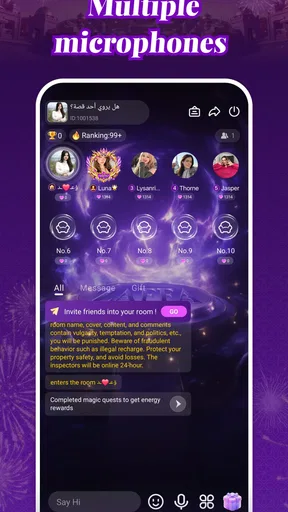


Our Review of ZaffaLive - Voice Chat Room
 Analysis by Appyee
I approached ZaffaLive as a social app built around voice chat rooms rather than as a conventional one-to-one messenger. Its appeal is easy to understand: you enter a shared space, listen, speak when invited or when the room allows it, and spend time with people who are online at the same moment. That makes it a better fit for casual company than for carefully planned conversations.
My overall impression is mixed but fairly clear. The app has a simple social idea that can work well when a room has friendly, active participants. At the same time, the experience depends heavily on the quality of the rooms you find, your comfort with meeting strangers, and your willingness to deal with a mature social environment. With an average rating of 3.0 from around 1.1 thousand ratings, it feels like a service that still needs refinement rather than a polished replacement for every established chat platform.
How ZaffaLive feels in everyday use
The first thing I noticed is that ZaffaLive is designed for presence. It is less about sending a message and waiting for a reply, and more about joining an ongoing atmosphere. That distinction matters. If you want a quick answer from a friend, a standard messenger is usually more efficient. If you want background conversation while relaxing, meeting new people, or participating in a live discussion, a voice-room app makes more sense.
I can imagine using it at the end of the day when I do not want to arrange a formal call. I might browse for a room that matches my mood, listen for a while, and decide whether speaking adds anything. That low-commitment pattern is one of the strongest reasons to try it. You do not necessarily need to prepare a topic or invite a group before getting started.
That same openness can also make the experience uneven. A room can be lively one moment and quiet the next. Conversation may be welcoming, or it may already revolve around inside jokes that are difficult for a newcomer to follow. I would not install this expecting a guaranteed stream of meaningful discussion. I would install it expecting a social space whose value changes with the people currently using it.
The app is free to install, which lowers the barrier for experimenting. However, optional purchases range from $0.99 to $199.99 per item, so I would be careful before spending money. A free entry point is useful, but it does not automatically mean every part of the social experience is cost-free. I would first understand what the paid elements do and whether they genuinely improve my use before buying anything.
Who is most likely to enjoy it
ZaffaLive is best suited to adults who enjoy spontaneous conversation and do not mind entering rooms without knowing exactly what will happen. It may appeal to someone who wants to make casual social connections, practice speaking with unfamiliar people, or simply listen while doing a routine task. It can also suit users who find text-based communities tiring and prefer hearing real voices.
I would be more cautious recommending it to someone who wants a private, controlled communication tool. Families looking for a simple way to stay in touch have better options in ordinary video and messaging apps. Likewise, anyone who dislikes public or semi-public conversation may find the room format uncomfortable rather than liberating.
The mature 17+ rating is important, not decorative. I would treat the app as an adult-oriented social environment and avoid presenting it as suitable for younger users. Even when a room appears harmless, live conversation can change quickly because people are speaking in real time. That is a practical reason to stay alert, leave uncomfortable rooms promptly, and avoid sharing personal information with strangers.
A practical way to start without wasting time
My recommended approach is to spend the first session observing rather than trying to become active immediately. Listen to several rooms, notice whether people take turns, and see how newcomers are treated. This gives you a better sense of the community than judging the app from a single conversation.
A useful habit is to decide on a personal exit rule before joining. For example, if the room becomes hostile, overly personal, or simply irrelevant, leave instead of hoping it will improve. Voice platforms can create social pressure because leaving is more visible than closing a text thread, but you do not owe a room your time.
I would also keep my first conversations general. Talking about music, hobbies, films, travel ideas, or daily routines is safer than revealing where I live, where I work, or how to contact me elsewhere. The voice format can create a false sense of familiarity, especially when a conversation feels warm. That emotional shortcut is exactly why boundaries matter.
What the current release tells me about its direction
The current version is 1.40.154, and the app was released on December 15, 2025. Those details place ZaffaLive in a relatively early stage of its public life. I see that as both an opportunity and a warning: the product can still develop quickly, but users may encounter rough edges that a mature platform has already solved.
The developer is listed as JIASho24. The app has reached over 100 thousand installs, which suggests that the concept has attracted a meaningful audience beyond a small experiment. Still, that figure should not be confused with a guarantee that every room will be active or that the same people will be available whenever you open the app. A social service can have broad reach while feeling quiet at the exact time one person logs in.
Because the version and release information are relatively recent, I would pay attention to how consistently the app improves between updates. The most valuable progress for a voice-room service is not simply adding more decorative elements. I would want to see smoother room discovery, clearer controls, dependable audio behavior, and better ways to manage unwanted interactions. Those improvements directly affect whether a session feels comfortable.
I also think the app’s short store description, “ZaffaLive,” tells a user very little about the actual experience. That is not a criticism of the underlying idea, but it does mean a new user may need to learn by exploring. The broader summary presents Zaffa as a place to chat and stay together, yet the practical question is how well the available rooms support that promise at the moment you arrive.
For existing users, a newer version can be encouraging because it shows that the app is being maintained. But I would not assume that a version number alone means every major annoyance has disappeared. Product evolution should be judged by the daily details: can I find a suitable room quickly, understand what is happening, control my participation, and leave without friction?
How it compares with familiar alternatives
Compared with ordinary messaging apps, ZaffaLive offers more immediacy and less planning. A text conversation gives me time to edit my words and choose exactly who receives them. A live room gives me spontaneity and a sense of being present with a group. The trade-off is control. If privacy, permanence, and precise audience selection matter most, I would choose a conventional messenger.
Compared with large community platforms that include voice channels, ZaffaLive appears more focused on the room itself. That can make the experience feel less complicated for someone who wants to enter a conversation without managing a large community structure. On the other hand, established community services often provide more familiar tools for organizing groups, maintaining topics, and controlling membership. I would choose ZaffaLive for casual discovery, not automatically for building a serious long-term community.
It also differs from a video-call service. A video call is usually arranged around known participants and a specific purpose. ZaffaLive is closer to dropping into a social lounge. That makes it more flexible for unplanned interaction, but less predictable for focused meetings, private support, or important discussions.
The right comparison therefore depends on the job. For a quick conversation with people I already know, I would use a messenger. For a structured group with recurring topics, I would lean toward a community platform. For spontaneous voice-based socializing, ZaffaLive has a clearer reason to exist.
Where the experience still needs care
The biggest weakness is dependence on room quality. No interface can manufacture a good conversation if the participants are inactive, disruptive, or uninterested in welcoming newcomers. This is a fundamental challenge for social apps, and it means my experience may differ sharply from another user’s experience on the same day.
Discoverability is another area I would watch. A new user needs to understand why one room is worth entering instead of another. If room names or descriptions are vague, browsing becomes guesswork. The best social design helps people find the right level of activity and the right subject without forcing them to enter many unsuitable rooms first.
Voice communication also has practical friction that text does not. Background noise, people speaking over one another, uneven volume, and awkward pauses can quickly make a room tiring. I would use headphones when possible and keep my microphone muted whenever I am not speaking. That simple habit improves the experience for everyone and prevents accidental private conversations from becoming public.
Safety and moderation deserve particular attention in a mature live environment. I would not assume that every room is equally well managed. If a conversation crosses a boundary, the sensible response is to leave, use the available reporting or blocking controls if appropriate, and avoid escalating the exchange. A social app should make those actions easy to find; as a user, I would test them early rather than searching for them during a stressful moment.
The purchase range also changes how I evaluate the app. I am comfortable trying a free social app, but I would not let virtual spending become the measure of participation. Before making any purchase, I would ask whether it improves communication or merely adds pressure to compete for attention. That distinction is especially important in apps where social status can influence how visible or welcomed someone feels.
What I would like to see next
For ZaffaLive to become a stronger long-term choice, I would look for improvements that make the social experience easier to judge before joining. Clearer room context, useful ways to return to good conversations, and straightforward controls for muting or leaving would all have practical value. These are not flashy additions, but they reduce the uncertainty that currently comes with entering a live room.
I would also watch whether the community becomes more consistent as the install base grows. More users can bring more variety, but growth alone does not guarantee better conversations. The important question is whether newcomers can find active rooms, participate without feeling pushed aside, and recognize which spaces match their interests.
For someone considering installation now, my advice is simple: treat it as an experiment, not as your only communication app. Try it when you have time to explore, keep personal boundaries in place, and judge it by the rooms you can actually enjoy rather than by the promise of endless social activity.
My recommendation is cautious but positive for adults who specifically want spontaneous voice rooms. ZaffaLive has a clear social purpose, a free starting point, and enough reach to make discovery worthwhile. Its 17+ rating, variable room quality, and optional purchases mean it is not ideal for children, private communication, or users who want a fully predictable experience.
I would keep it installed if I enjoyed finding casual conversations and was willing to filter the community myself. If I needed reliable contact with friends, organized group collaboration, or stronger control over who participates, I would choose a more established alternative. ZaffaLive is most convincing when used as an open social lounge: useful in the right moment, enjoyable with the right people, but not a universal replacement for every kind of chat.
Verdict
Strengths of ZaffaLive - Voice Chat Room
- Easy to join live voice rooms and start conversations quickly.
- Offers a social space for meeting people with shared interests.
- Real-time voice interaction feels more personal than text chat.
- Room discovery helps users find active conversations easily.
- Useful for practicing communication and building online connections.
Limitations of ZaffaLive - Voice Chat Room
- Public rooms may include inappropriate language or uncomfortable behavior.
- Busy rooms can make it difficult for new users to be heard.
- Requires a stable internet connection for smooth voice playback.
- Privacy depends on how carefully users manage personal information.
- Some features or interactions may be limited without in-app purchases.
Similar Picks in This Category
View All
Meta Platforms, Inc.4.6

Instagram4.0

Likee-Live, Chat & Party Games
Likeme Pte. Ltd.4.4

Facebook Lite
Meta Platforms, Inc.4.5

TikTok - Videos, Shop & LIVE
TikTok Pte. Ltd.4.0

Moj: Free Short Drama & Reels
ShareChat4.1
Frequently Asked Questions
What is ZaffaLive - Voice Chat Room?
ZaffaLive - Voice Chat Room is a social audio application focused on live voice conversations. After joining available rooms, users can listen to ongoing discussions, request a speaking turn, chat with other participants, and meet people with similar interests. The experience is primarily voice-based rather than video-based, making it suitable for casual conversations, group discussions, entertainment, and community interaction from a mobile device.
How do voice rooms work in ZaffaLive?
Voice rooms generally allow several users to participate in the same live conversation, while other members listen as an audience. Depending on the room settings, you may be able to raise your hand, receive permission to speak, send messages, or use reactions. Room hosts or moderators usually manage speakers and can remove disruptive participants. Because conversations are live, availability and topics may change throughout the day.
Is ZaffaLive free to download and use?
ZaffaLive can typically be downloaded without an upfront purchase, but some features may depend on the app’s current monetization system. Social audio platforms may offer optional virtual gifts, coins, premium benefits, or other in-app purchases. Before spending money, review the pricing shown inside the application and check whether subscriptions or purchases renew automatically through Google Play or the App Store.
Does ZaffaLive require an account, microphone, or special permissions?
You may need to create or connect an account to use the main social features, such as entering rooms, following users, or maintaining a profile. Microphone access is normally required only when you want to speak, while listening may not require microphone permission. The app could also request notifications, storage, or other permissions depending on its features. Review each permission and enable only what you are comfortable using.
Is ZaffaLive safe for children and private conversations?
Live voice rooms contain user-generated content, so conversations can vary in language, maturity, and subject matter. Parents should check the app’s age rating, privacy policy, moderation tools, and account controls before allowing a child to use it. Avoid sharing phone numbers, addresses, passwords, financial details, or private photographs. Use blocking and reporting features when necessary, and remember that live conversations may not always be fully moderated.
